

Part 1: Foundation Preparation
Q1: What basic materials are needed to build a warship?
- Structural Materials: Black Concrete, White Quartz Blocks, and Gray Concrete form the main color scheme of the hull. Dark Oak Planks are suitable for decking, and Polished Andesite works well for the superstructure.
- Detail Decoration: Sea Lanterns can replace beacons for lighting. Iron Bars combined with Cobwebs make rope/cable systems. Stained Glass is used for porthole designs.
- Tool Preparation: World Edit tools increase building efficiency. Fine Sandpaper (corresponding to Sandstone blocks in-game) handles edge transitions. Various knives (tools) are used for carving complex shapes.
Q2: How to choose the warship’s scale and overall configuration?
It is recommended to scale down real warship dimensions using a 1:3 or 1:5 ratio. Keep the hull length between 30-100 blocks, and avoid designing sharp angles with curvature exceeding 45°. First, use Wool blocks to outline the contour, determining the streamlined flow of the bow, stern, and sides.
Part 2: Framework Construction Techniques
Q3: What are the core steps for building the hull framework?
- Axis Positioning: Use Blue Wool to mark the ship’s central axis, serving as the symmetry reference for all structures.
- Curve Shaping: Start placing blocks from the point furthest from the axis to form an arc facing towards the axis, until it meets the centerline.
- Contour Expansion: Use World Edit’s copy-paste function to gradually expand the hull surface along the outer contour, remembering to leave gaps for air intakes and heat dissipation vents.
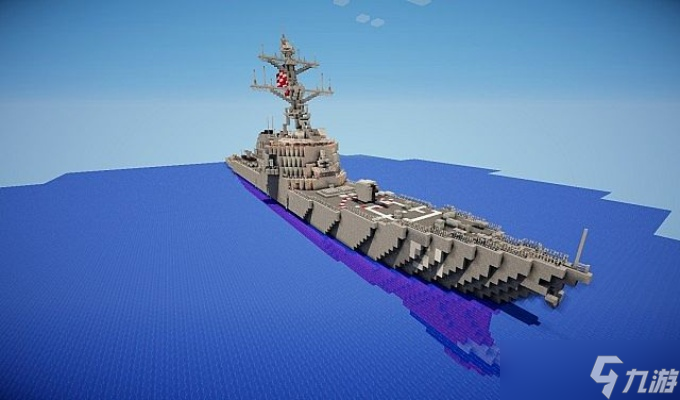
Q4: How to handle the underwater part of the hull?
The integrity of the underwater structure cannot be ignored. Use Deepslate Slabs to create a keel/base 36 blocks in length. Orange Concrete can mark the waterline. The hull shape follows the principle “wide hull for stability, narrow hull for speed.” Destroyers use a V-shaped bottom, while battleships use a U-shaped bottom.
Part 3: Structural Detailing Essentials
Q5: How to layout the superstructure?
- Superstructure: Use Polished Andesite as the main material, paired with Quartz Stairs to create a sense of depth/layers.
- Weapon Systems: Build turret bases with Stone Bricks, use End Rods to represent gun barrels.
- Masts & Smokestacks: Employ a gray-white color scheme, using Iron Bars and Banners to enhance realism.
Q6: How to handle deck details?
- Flight Deck: Aircraft carriers use brightly colored Concrete to mark landing/takeoff zones. Battleships use Dark Oak Slabs to simulate wooden deck textures.
- Facility Arrangement: Simulate anchor winches using Hoppers and Trapdoors. Lifeboats can be made from Stained Clay.
Part 4: Painting & Special Effects
Q7: How to enhance visual effects through color?
The base color determines the overall look. Use a gradient technique: apply a light base color first, then layer darker colors. Simulate deck wood grain by alternating Brown Terracotta and Dark Oak Wood. For side markings, first use White Concrete as a base, then use Stained Wool to draw numbers/codes.
Q8: How to create dynamic battle scenes?
A ship under attack can show damage through smoke effects (Campfires combined with Trapdoors) and a tilted hull design. Add splashing Quartz block fragments at the bow and stern, combined with Red Wool to simulate fire scenes.
Part 5: Environmental Integration Techniques
Q9: How to organically integrate the warship with the aquatic environment?
- Calm Water Scene: Use Blue Glass Panes to create clear seawater, dotted with Sea Lanterns for underwater lighting.
- Special Sea Areas: For example, pair the USS Missouri battleship with an icy environment, using White Concrete and Blue Ice blocks to create a polar atmosphere.
- Battle Environment: Simulate a smoke-filled naval battle scene using TNT explosion debris and Stained Glass for fog effects.
Part 6: Advanced Optimization Plans
Q10: What are some secrets to improve construction efficiency?
- Modular Construction: Divide the warship into three independent modules (hull, superstructure, weapon systems) for parallel building.
- Texture Substitution: Use simplified textures for parts meant to be viewed from afar to reduce complexity, e.g., using Diamond Blocks instead of Gray Concrete.
- Symmetrical Building: After completing the structure on one side of the axis, use World Edit’s mirror/copy function to quickly generate the other side.
Q11: How to solve common construction problems?
If curved structures get out of control, return to the axis to recalibrate the contour. For color disharmony, refer to real warship photos to adjust the color scheme. For proportion issues, re-mark key dimension nodes using Wool blocks.


